Idle Gauds Jewelry and Metals
Shakespeare Sonnet 17 Ring // Hand-carved ring in argentium sterling silver // Quill and inkwell ring // Writer's ring
Shakespeare Sonnet 17 Ring // Hand-carved ring in argentium sterling silver // Quill and inkwell ring // Writer's ring
Couldn't load pickup availability
Share
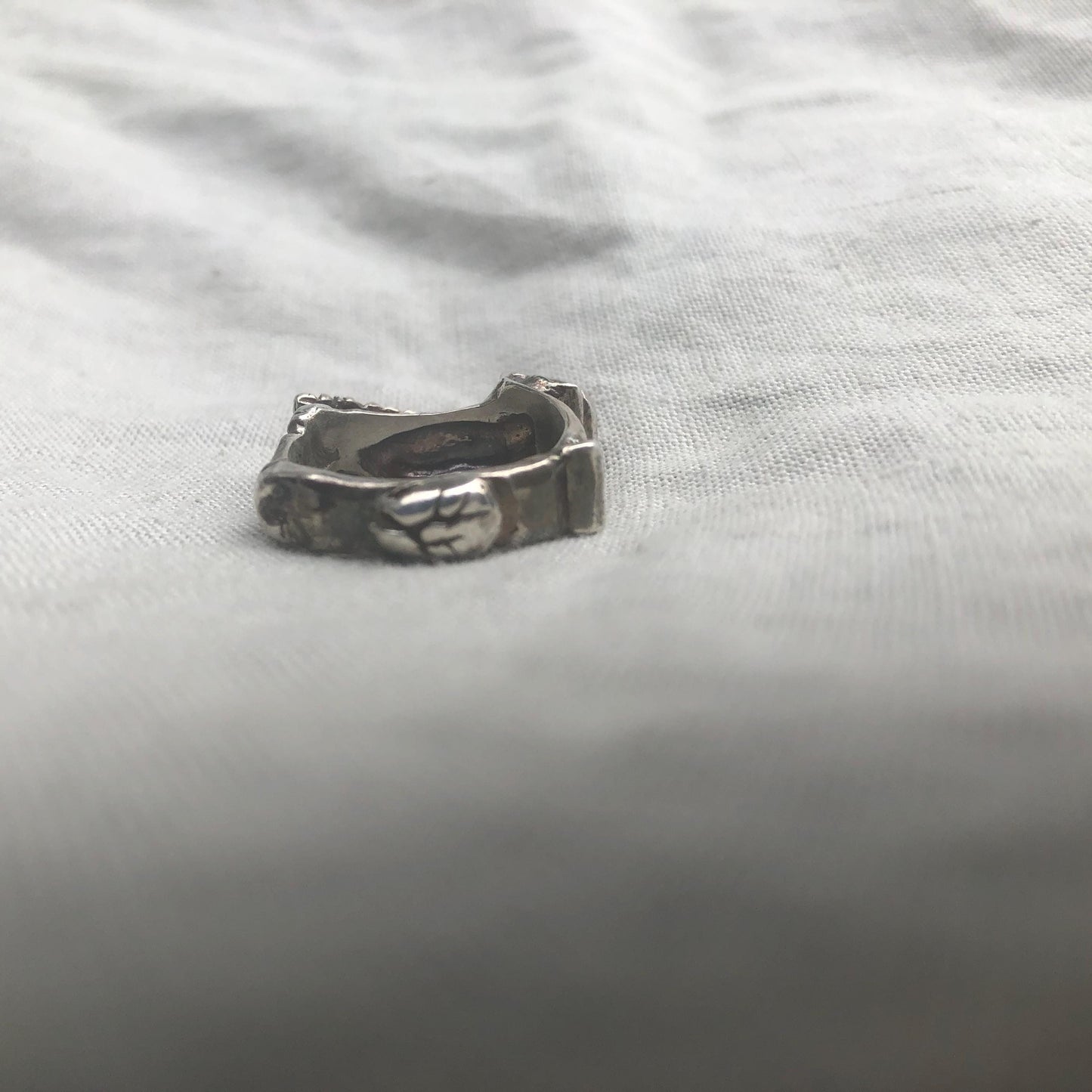
This ring transforms Shakespeare's Sonnet 17 into physical form. The ring is in stock in sizes 7 1/2 and 7 3/4. Other sizes are custom order.
This is a poem for writers and lovers. The poet is worried about whether his poetry is good enough. On the one hand, he hasn't yet written the kind of poem that he would like to be able to write: his poetry is like the beloved's "tomb," not a true picture. On the other hand, even if he were able to "write the beauty of your eyes," the resulting poem wouldn't be believable. The beloved is so beautiful that a poem truly capturing their beauty would seem like poetic license.
In the ring, the poet's anxiety becomes four images: a quill pen uneasily balanced on an inkwell; a blank page, curling at the ends to show its antiquity; a bone; and, on the bottom below the wearer's finger, a cracked egg. The blank page suggests a poem that hasn't been written yet but is also somehow already old, as if we're seeing it from two different vantage points in time. The bone and the egg together suggest the passage of time, the possibility of future life, and the inevitability of death. The egg is cracked: does this mean that it's hatching, or that it's broken and will never hatch?
***
Who will believe my verse in time to come
If it were filled with your most high deserts?
Though yet, heaven knows, it is but as a tomb
Which hides your life and shows not half your parts.
If I could write the beauty of your eyes
And in fresh numbers number all your graces,
The age to come would say “This poet lies;
Such heavenly touches ne’er touched earthly faces.”
So should my papers, yellowed with their age,
Be scorned, like old men of less truth than tongue,
And your true rights be termed a poet’s rage
And stretchèd meter of an antique song.
But were some child of yours alive that time,
You should live twice—in it and in my rhyme. (William Shakespeare, Sonnet 17)